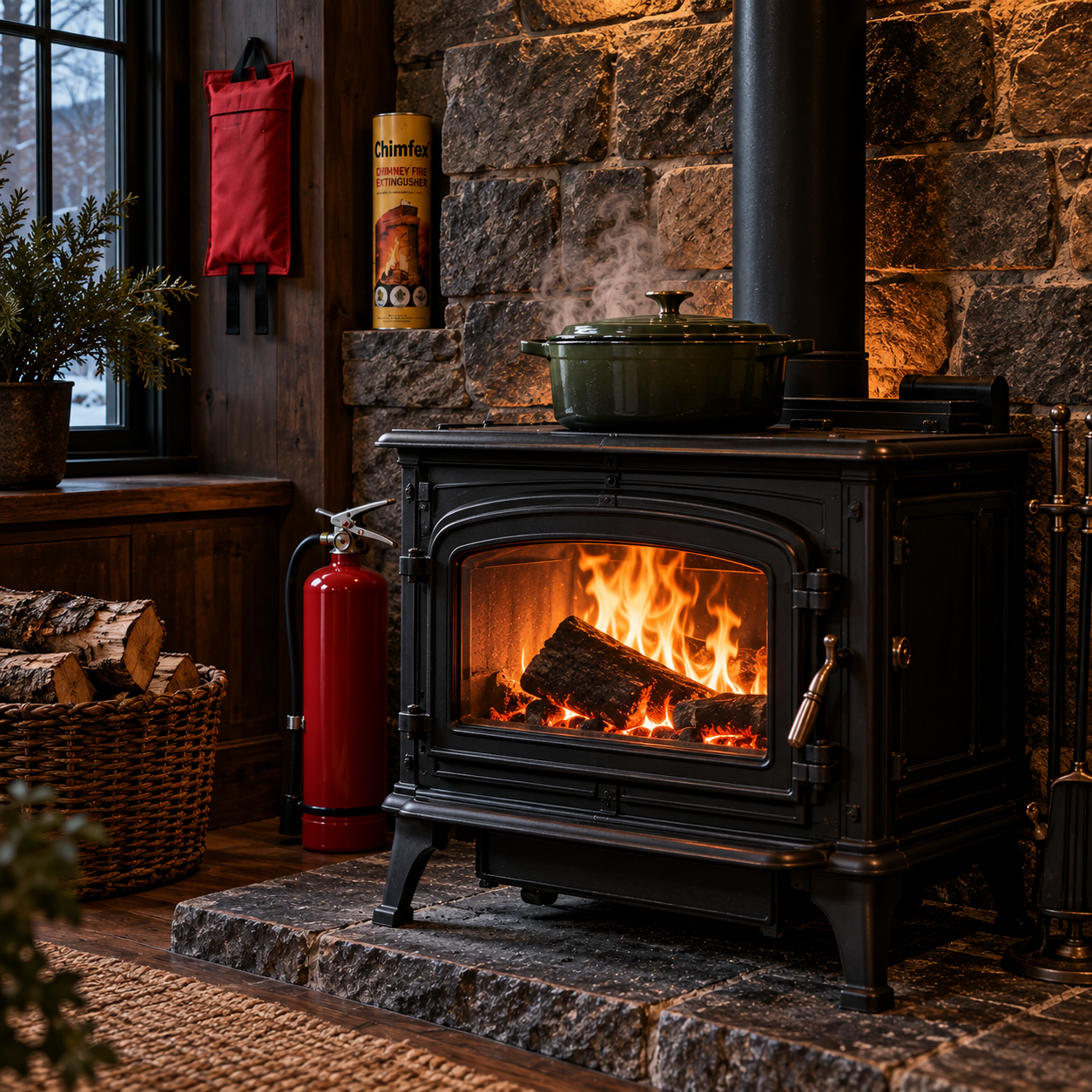
Smoke alarms and fire extinguishers are fundamental to home fire safety, but they aren’t the only products designed to protect against household fires. Despite addressing hazards that standard equipment may not be designed to handle, several specialized home fire safety products remain relatively unknown.
From holiday cooking to wood-burning fireplaces and seasonal decorations, household fire risks take different forms. So does the equipment developed to address them.
Chimney Flares
Chimney fires can reach temperatures exceeding 2,000°F, making rapid suppression critical. Chimney flares are specialized devices designed to interrupt combustion inside the flue without directing water into a superheated chimney.
Products like Chimfex are activated by striking an ignition surface, releasing chemical suppressant fumes that travel upward through the chimney. Compact enough to store near a fireplace or wood stove, they offer a specialized approach to a hazard that conventional household extinguishers aren’t designed to address.
Get the chimney flare we use #commissionearned
Fire Blankets
Fire blankets are designed to extinguish certain small, contained fires by restricting the oxygen needed to sustain combustion. Unlike conventional extinguishers, they require no pressurized chemicals and leave behind no extinguishing residue.
Typically constructed from tightly woven fiberglass, household fire blankets fold into compact, wall-mountable pouches for convenient storage. Available in several sizes, they are commonly intended for kitchen fires and other small household fire hazards. Look for products tested to recognized fire blanket standards, including EN 1869, rather than general-purpose heat-resistant fabrics.
Automatic Stovetop Fire Suppressors
Automatic stovetop fire suppressors are designed to detect and suppress certain cooking fires without manual intervention. These compact devices are installed above the cooking surface, providing targeted protection in an area where grease and cooking oil fires can escalate rapidly.
Products like StoveTop FireStop use canisters mounted beneath compatible range hoods. When flames reach a heat-sensitive fuse, the device automatically releases a dry chemical extinguishing agent over the affected burners. Operating without batteries, electrical connections, or electronic sensors, these systems offer an additional layer of kitchen fire protection. Installation requirements and burner coverage vary by model.
Explore Automatic Stovetop Fire Suppressors #ad
Fire Suppression Sprays
Fire suppression sprays offer a lightweight, compact addition to household fire safety equipment. Packaged in aerosol-style cans, they’re generally easier to handle than traditional extinguishers, with straightforward spray mechanisms that may be especially beneficial for individuals with limited strength or mobility.
Available in formulations designed for different types of fires, including ordinary combustibles and certain cooking-related fires, these sprays provide options for specific household hazards. Their smaller size also makes them convenient to store in kitchens, garages, and other areas where quick accessibility matters.
Explore Fire Suppression Sprays #ad
Bonus: Fire Escape Ladders
Fire escape ladders provide an alternative evacuation route from upper-story windows when conventional exits are inaccessible. Designed for residential emergencies, these portable ladders can be stored discreetly in bedrooms and deployed without permanent exterior installation.
Most models feature collapsible metal rungs supported by heavy-duty straps or chains, with mounting hooks designed to secure over compatible windowsills. Available in two- and three-story lengths, fire escape ladders vary in weight capacity, construction, and window compatibility. Models with slip-resistant rungs, sturdy mounting hardware, and documented safety testing offer important features to consider.
Explore Fire Escape Ladders #ad
Fire Extinguisher Balls: A Serious Safety Warning
Marketed as an innovative, hands-free approach to fire suppression, fire extinguisher balls are designed to activate when exposed to flames, dispersing extinguishing powder into the surrounding area. Their automatic operation may sound appealing, but serious safety concerns tell a different story.
The U.S. Consumer Product Safety Commission (CPSC) has issued warnings against multiple brands after testing revealed failures to extinguish fires, potentially exposing consumers to serious injury or death.
We recommend avoiding the use of fire extinguisher balls as a means of household fire protection.
The National Fire Protection Association recommends keeping a portable fire extinguisher on every level of the home, with additional extinguishers readily accessible in higher-risk areas, including kitchens and garages. Complementing traditional extinguishers with specialized equipment, including fire blankets, chimney flares, and automatic stovetop fire suppressors, can provide additional layers of protection against different household fire hazards.
Fire Safety Disclaimer: This article is intended for informational purposes only and does not constitute professional fire safety advice. Fire suppression products vary in their capabilities, applications, and limitations. Always follow manufacturer instructions, verify product compatibility, and choose equipment that meets applicable safety standards. These products are intended to supplement—not replace—working smoke alarms, properly maintained fire extinguishers, and a household evacuation plan. In the event of a fire, prioritize evacuation and contact emergency services.
Leave a Reply